Gen Z Made Japan the World's Most Romanticized Destination—— Now They're Tearing Down the Fantasy


Japan's record 42.7 million foreign visitors in 2025 and the viral TikTok backlash against its curated "perfect" aesthetic arrived the same year — because they came from the same source.
Key insights
- Japan welcomed 42.7 million foreign visitors in 2025 — an all-time record, up 15.8% from 2024, with ¥9.5 trillion (~$60.2 billion) in visitor spending, per JNTO via the Japan Times
- Gen Z and millennial bookings to Japan surged 1,300% since 2019, making Japan #1 dream destination for ages 13–39 for the third consecutive year, per American Express Travel and YPulse
- Kyoto's hotel tax increased 900% at the luxury tier effective March 2026; Japan's departure tax tripled to ¥3,000 effective July 2026
- Regional Japan saw +14% international visitor growth in 2025 while Tokyo, Kyoto, and Osaka collectively declined -0.8%, per JNTO via Travel Voice
The same generation that drove a 1,300% surge in Japan bookings is now producing viral TikTok content satirizing the "perfect Japan" aesthetic they helped create — and the Japanese government is responding with a tax structure designed to price out the tourists that aesthetic attracted. Japan's 2025 record of 42.7 million visitors and the simultaneous backlash against its curated image are not contradictory signals. They are the same trend at two different stages: mass aspirational demand arriving, and the infrastructure responding to the consequences of that arrival. The tourism industry built on Gen Z's romanticized version of Japan now has to figure out how to monetize authenticity instead — and nobody has solved that at scale yet.
Japan closed 2025 with 42.7 million foreign visitors — an all-time record, up 15.8% from 2024, with ¥9.5 trillion (~$60.2 billion) in visitor spending, also a record, according to the Japan National Tourism Organization (JNTO) via the Japan Times. In the same period, a viral TikTok genre emerged that the Taipei Times called the "Japan effect": Gen Z creators satirizing the filtered, hyper-romanticized "perfect Japan" aesthetic — the torii-gate-at-golden-hour videos, the cherry-blossom-season pilgrimages, the immaculate convenience store content — as performance rather than experience. The record and the reckoning were not opposites. They were the same phenomenon at different stages of the same generational mood.
How Japan Became the New France — and Why That Was Always a Fragile Position
Japan didn't just become popular. It became specifically, characteristically Gen Z popular — the kind of demand driven by identity construction, not just tourism. Gen Z and millennial bookings to Japan surged 1,300% since 2019, according to American Express Travel data cited by Fortune in February 2026. Japan ranked #1 dream destination for ages 13–39 for the third consecutive year, according to YPulse's March 2026 survey. Fortune described it explicitly: Japan has "replaced France as the country young Americans obsessively romanticize" — with anime, street food, and cherry blossoms serving not just as experiences but as identity anchors, ways of signaling who you are and what you value.
That's a different kind of tourism from "seeing the sights." It's aspirational, curated, and intensely image-conscious — which means it doesn't survive contact with reality quite as easily as regular sightseeing does. The version of Japan that drove 1,300% booking growth was a TikTok Japan: architecturally precise, aesthetically consistent, filtered into a dreamscape of calm and order. The Japan that 42.7 million people actually visited in 2025 was a Japan with 42.7 million other visitors in it, all trying to recreate the same images. The destination that promises to make you feel like the only person who truly understands Japan cannot remain that destination when it is simultaneously the most visited country in the world by your exact demographic.
The Backlash Arrives From the Same Direction as the Boom
On TikTok, the "Japan effect" genre didn't emerge as a critique from people who disliked Japan. It emerged from the same Gen Z cohort that was still booking flights — a self-aware dissection of the gap between the curated content and the lived experience, per Taipei Times (March 25, 2026). Kyoto's Gion district implemented photography bans in response to tourists treating its residential alleyways as open-air photo sets. The town of Fuji Kawaguchiko installed a large curtain blocking its most famous Mt. Fuji photo angle to deter crowds. Kamakura introduced crowd management restrictions on its iconic routes. These aren't abstract policy responses — they're specific answers to a specific phenomenon: a large number of people showing up to recreate the same twelve images they saw on social media.
The structural irony is precise. The content economy that built Japan's #1 dream destination status is now producing the meta-content that satirizes the consequences of being #1. The same platform, the same demographic, the same content format — just at a later point in the cultural cycle. This was always the trajectory for any destination that becomes aspirationally significant before its infrastructure is designed for the volume that aspiration generates. The backlash is not a reversal of the trend; it is the trend's next chapter.
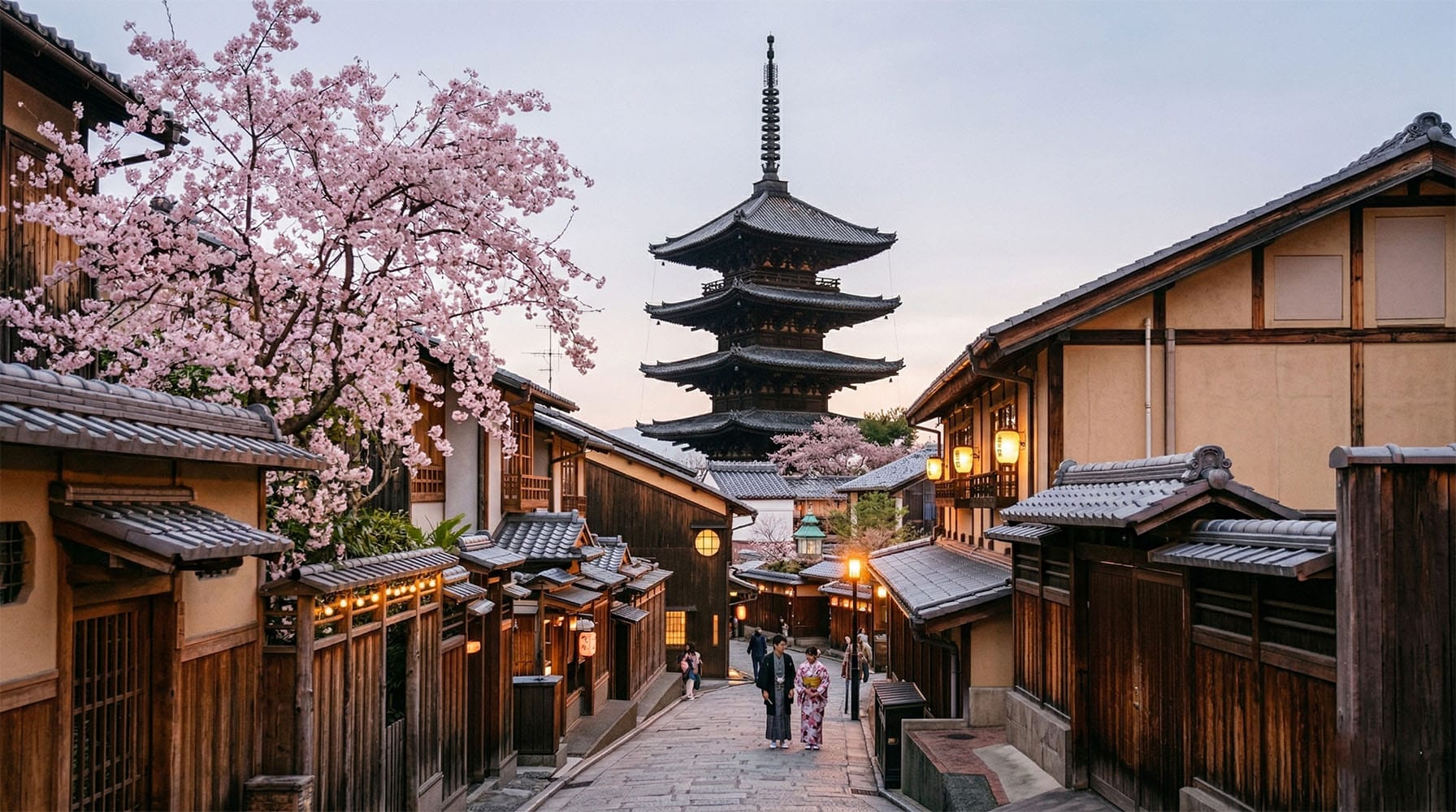
Kyoto's 900% Hotel Tax Is the Government Pricing Out Its Own Aesthetic
The Japanese government's response to the overtourism problem has been deliberate, graduated, and — from a market design standpoint — pointed. Kyoto approved a hotel tax increase from ¥200–500 to ¥400–¥10,000 per person per night, effective March 2026: a 900% increase at the luxury tier, the highest accommodation tax in Japan. Japan's departure tax tripled to ¥3,000, effective July 2026. The country converted tourist shopping from tax-free to full consumption tax as of November 1, 2025, adding roughly 10% to the cost of retail purchases. These are not anti-tourism measures. They are sorting mechanisms, designed to select for the tourist willing to pay more and screen out the tourist who came primarily because the weak yen and the aspirational aesthetic made Japan feel both affordable and obligatory.
The pricing is already reshaping the composition of who visits. Chinese visitors, who made up a significant portion of the budget-driven post-pandemic recovery traffic, collapsed 60–61% year-over-year in early 2026, according to Bloomberg and CNBC. South Korea surged 28.2% to become Japan's largest monthly source market in February 2026; US arrivals rose 14.7% in the same period. The country is, in effect, trading volume for per-visitor yield — a strategic pivot that the ¥9.5 trillion in 2025 visitor spending suggests is already working at the top end.
What "Authentic Japan" Means When It Becomes the Product
Regional Japan is the answer the government is actively pointing to. International visitors to Japan's regional areas grew 14% in 2025, while Tokyo, Kyoto, and Osaka collectively saw -0.8% growth — the first concrete evidence that the dispersal strategy is actually moving traffic, according to JNTO via Travel Voice. The logic is coherent: smaller cities absorb overflow, distribute economic benefit more broadly, and offer the "unfiltered" experience that the TikTok backlash says Gen Z is now looking for. JTB Tourism Research & Consulting projects 41.4 million visitors for 2026 — a 2.8% year-over-year decline, the first projected decrease in years — which, if accurate, is an intentional contraction, not a failure.
The unresolved question is whether "authentic Japan" is a sustainable product category or a temporary gap. The regional ryokan in a town no influencer has filmed yet is authentic precisely because no one has filmed it. The moment it becomes the new itinerary recommendation, it faces the same dynamics as Gion. JTB's projected 41.4 million for 2026 would still represent one of the highest inbound visitor counts in Japan's recorded history. For the smaller cities now positioned to capture overflow from overtouristed urban centers, the window to build real economic infrastructure around this shift — before the content economy catches up — is open, but it isn't wide.


